


Project
When a family member tested positive for Covid and needed to isolate themselves to prevent others from becoming sick, their cat ran away. Not knowing what to do, the family frantically googled their nearest non-profit animal shelter, NYACC, to report their cat missing. While using the site, the family felt even more overwhelmed by the reporting process as the website’s congested interface made them feel less confident that their pet will be found. To prevent this situation from happening again, I reached out to the non-profit organization and offered to update the company’s database interface and information architecture to increase the likelihood of reuniting lost pets.
When a family member tested positive for Covid and needed to isolate themselves to prevent others from becoming sick, their cat ran away. Not knowing what to do, the family frantically googled their nearest non-profit animal shelter, NYACC, to report their cat missing. While using the site, the family felt even more overwhelmed by the reporting process as the website’s congested interface made them feel less confident that their pet will be found. To prevent this situation from happening again, I reached out to the non-profit organization and offered to update the company’s database interface and information architecture to increase the likelihood of reuniting lost pets.
When a family member tested positive for Covid and needed to isolate themselves to prevent others from becoming sick, their cat ran away. Not knowing what to do, the family frantically googled their nearest non-profit animal shelter, NYACC, to report their cat missing. While using the site, the family felt even more overwhelmed by the reporting process as the website’s congested interface made them feel less confident that their pet will be found. To prevent this situation from happening again, I reached out to the non-profit organization and offered to update the company’s database interface and information architecture to increase the likelihood of reuniting lost pets.
When a family member tested positive for Covid and needed to isolate themselves to prevent others from becoming sick, their cat ran away. Not knowing what to do, the family frantically googled their nearest non-profit animal shelter, NYACC, to report their cat missing. While using the site, the family felt even more overwhelmed by the reporting process as the website’s congested interface made them feel less confident that their pet will be found. To prevent this situation from happening again, I reached out to the non-profit organization and offered to update the company’s database interface and information architecture to increase the likelihood of reuniting lost pets.
When a family member tested positive for Covid and needed to isolate themselves to prevent others from becoming sick, their cat ran away. Not knowing what to do, the family frantically googled their nearest non-profit animal shelter, NYACC, to report their cat missing. While using the site, the family felt even more overwhelmed by the reporting process as the website’s congested interface made them feel less confident that their pet will be found. To prevent this situation from happening again, I reached out to the non-profit organization and offered to update the company’s database interface and information architecture to increase the likelihood of reuniting lost pets.
Time
August 2021, 2 weeks
Role
UX designer, researcher and information architect
UX designer, researcher and information architect
UX designer, researcher and information architect
Tools
Figma, Optimal Workshop, Miro
Figma, Optimal Workshop, Miro
Challenge
How might we best help shelter staff and pet owners burdened with cognitive overload, find their missing pets
How might we best help shelter staff and pet owners burdened with cognitive overload, find their missing pets
Solution
Design a standardized database for neighbors, shelter staff and pet owners which will alert when a pet with similar features is found
Develop a stronger Information architecture system to filter, find and categorize pets without Identification
- Incorporate AI facial recognition
Display expert pet finding tips
Design a standardized database for neighbors, shelter staff and pet owners which will alert when a pet with similar features is found
Develop a stronger Information architecture system to filter, find and categorize pets without Identification
- Incorporate AI facial recognition
Display expert pet finding tips
Design a standardized database for neighbors, shelter staff and pet owners which will alert when a pet with similar features is found
Develop a stronger Information architecture system to filter, find and categorize pets without Identification
- Incorporate AI facial recognition
Display expert pet finding tips
Secondary research
Secondary research
Secondary research
Secondary research
Secondary research
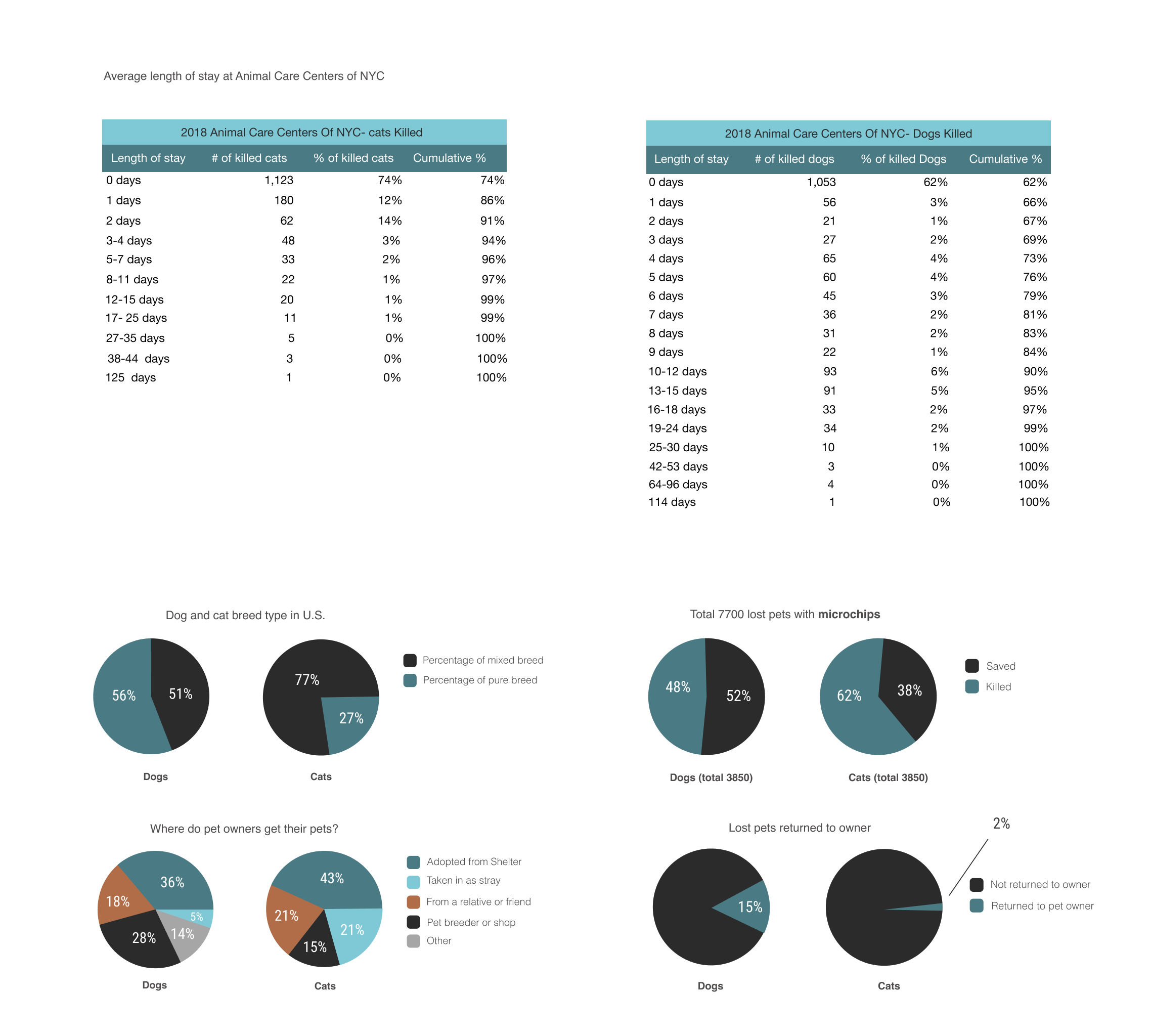
To better understand why pets get lost and the animal shelter’s role in preventing pet homelessness, I read through different articles from a wide range of sources. Some important findings include:
Key findings:
Twice as many animals enter the shelter as “strays” than they are to be relinquished by owners.
Shelters are not required to report to or manage a standardized database system
Pets have a short shelter stay and are euthanized frequently due to over crowdedness
Shelter workers are overworked, burned out and stressed, decreasing their cognitive ability to provide optimal care and help reunite pet with family.
Twice as many animals enter the shelter as “strays” than they are to be relinquished by owners.
Shelters are not required to report to or manage a standardized database system
Pets have a short shelter stay and are euthanized frequently due to over crowdedness
Shelter workers are overworked, burned out and stressed, decreasing their cognitive ability to provide optimal care and help reunite pet with family.
Twice as many animals enter the shelter as “strays” than they are to be relinquished by owners.
Shelters are not required to report to or manage a standardized database system
Pets have a short shelter stay and are euthanized frequently due to over crowdedness
Shelter workers are overworked, burned out and stressed, decreasing their cognitive ability to provide optimal care and help reunite pet with family.
Twice as many animals enter the shelter as “strays” than they are to be relinquished by owners.
Shelters are not required to report to or manage a standardized database system
Pets have a short shelter stay and are euthanized frequently due to over crowdedness
Shelter workers are overworked, burned out and stressed, decreasing their cognitive ability to provide optimal care and help reunite pet with family.
Twice as many animals enter the shelter as “strays” than they are to be relinquished by owners.
Shelters are not required to report to or manage a standardized database system
Pets have a short shelter stay and are euthanized frequently due to over crowdedness
Shelter workers are overworked, burned out and stressed, decreasing their cognitive ability to provide optimal care and help reunite pet with family.
Interestingly enough, I found a disconnect in information. According to experts, the best way to reduce shelter euthanasia is to provide identification for pets. However, microchips did not stop 48% of dogs and 62% of cats from being euthanized despite having it. Not to mention that microchips are rarely updated, sometimes keeping record of the previous owner if a pet has been re-adopted. The problem was worst than I originally thought.
How might we...
How might we...
How might we...
How might we...
How might we...
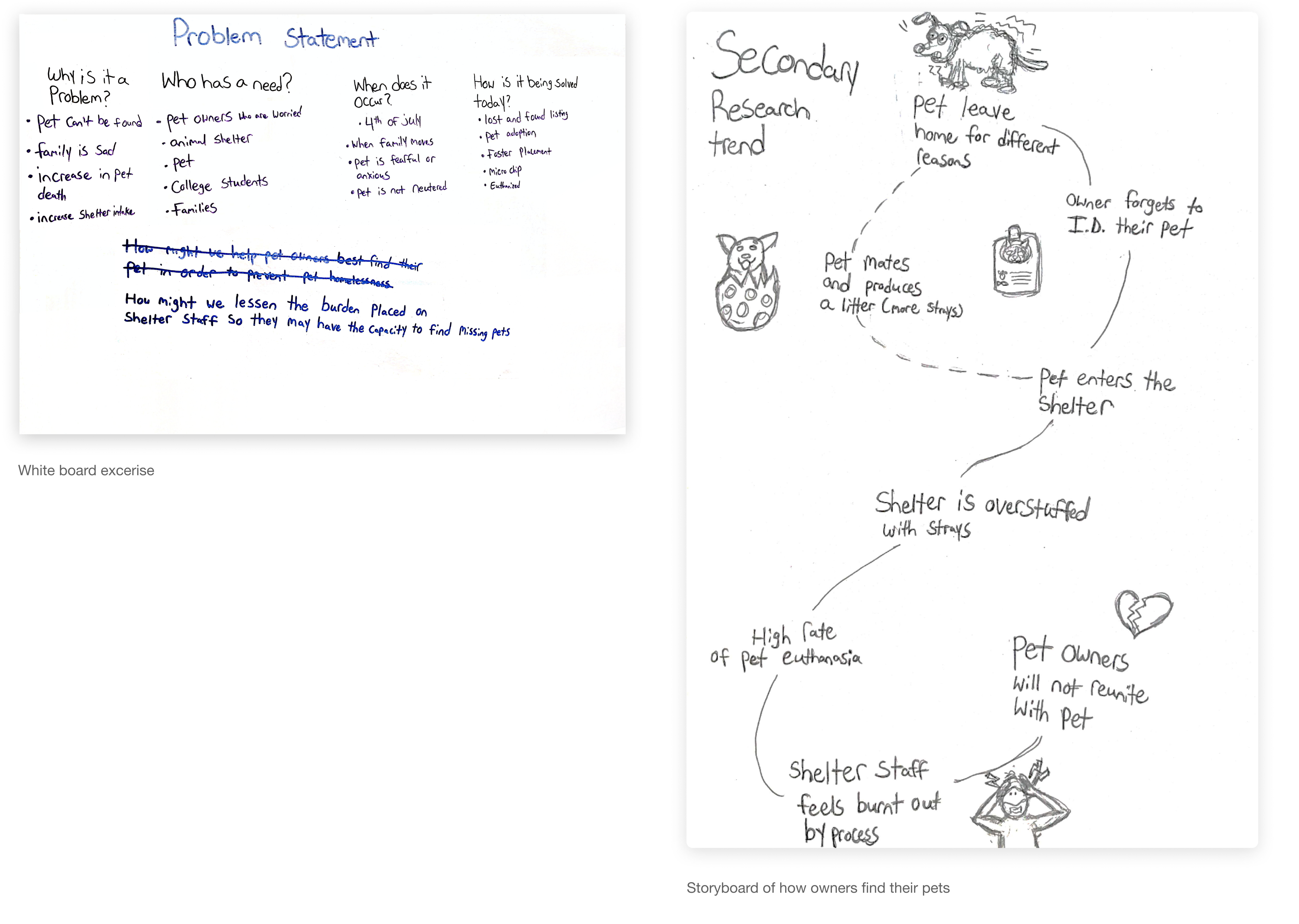
After gaining a better perspective, I crafted a problem statement. Surprisingly, I originally thought pet owners were our target audience, however, research indicates that Shelter Staff are also impacted. Our original problem statement has changed from “How might we help pet owners find their lost pets” to “how might we lessen the burden placed on shelter staff so they may have the capacity to help locate missing pets”.
Lingering assumptions and questions:
Do pet owners regularly give their pet identification (microchip, collar tag) and does this help lost pets come home?
Is there a consensus amongst pet owners regarding best practices of finding a lost pet?
Do owners consider contacting the shelter?
Do pet owners regularly give their pet identification (microchip, collar tag) and does this help lost pets come home?
Is there a consensus amongst pet owners regarding best practices of finding a lost pet?
Do owners consider contacting the shelter?
Do pet owners regularly give their pet identification (microchip, collar tag) and does this help lost pets come home?
Is there a consensus amongst pet owners regarding best practices of finding a lost pet?
Do owners consider contacting the shelter?
Do pet owners regularly give their pet identification (microchip, collar tag) and does this help lost pets come home?
Is there a consensus amongst pet owners regarding best practices of finding a lost pet?
Do owners consider contacting the shelter?
Do pet owners regularly give their pet identification (microchip, collar tag) and does this help lost pets come home?
Is there a consensus amongst pet owners regarding best practices of finding a lost pet?
Do owners consider contacting the shelter?
Survey
Survey
Survey
Survey
Survey
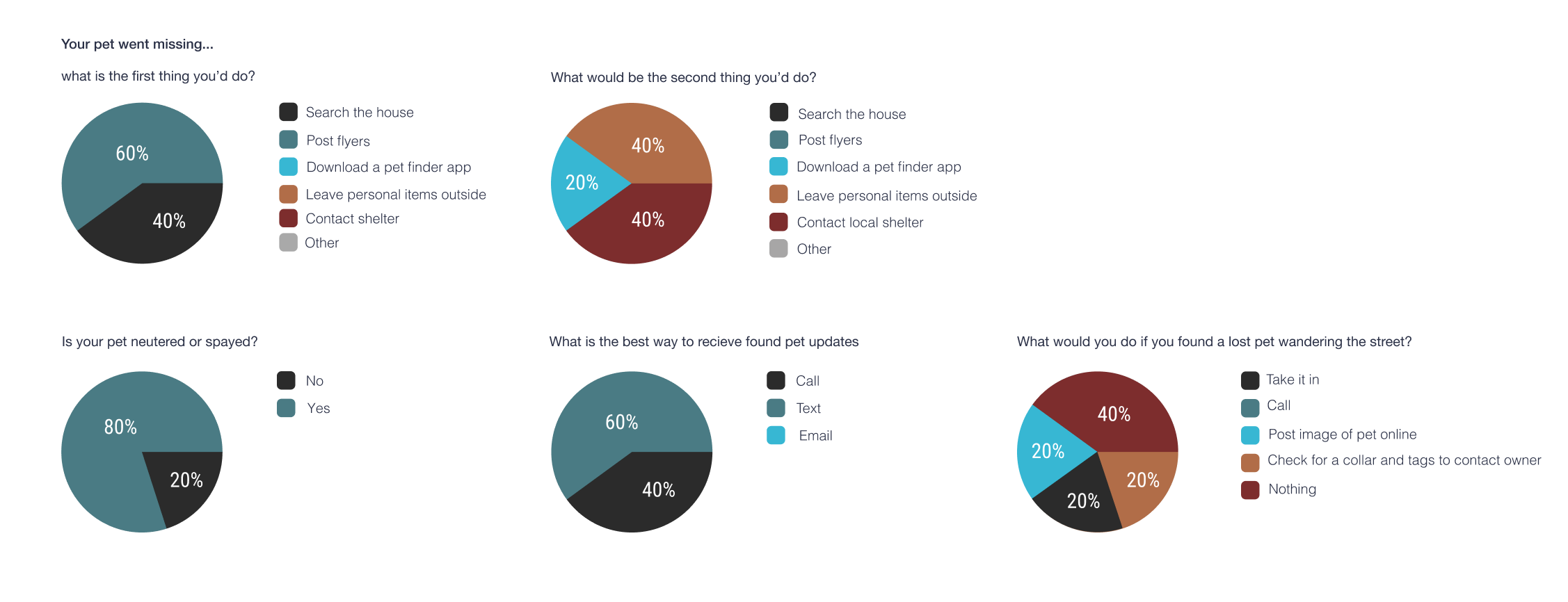
In order to define the types of research questions that should be targeted during the customer interview phase, I created a survey and distributed it throughout pet forums. Based on the results found during the secondary research, I wanted to get a better understanding of the way pet owners think and the steps they take to find there pet once missing.
Results:
60% of surveyors said they would search the house first if their pet went missing while 40% said they would post a sign
As a second step, only 40% said they would go to a shelter and another 40% said they would leave a personal item outside
Texting was the most preferable method of receiving pet updates
40% of testers mentioned that they wouldn’t do anything if they spot a lost animal
60% of surveyors said they would search the house first if their pet went missing while 40% said they would post a sign
As a second step, only 40% said they would go to a shelter and another 40% said they would leave a personal item outside
Texting was the most preferable method of receiving pet updates
40% of testers mentioned that they wouldn’t do anything if they spot a lost animal
60% of surveyors said they would search the house first if their pet went missing while 40% said they would post a sign
As a second step, only 40% said they would go to a shelter and another 40% said they would leave a personal item outside
Texting was the most preferable method of receiving pet updates
40% of testers mentioned that they wouldn’t do anything if they spot a lost animal
60% of surveyors said they would search the house first if their pet went missing while 40% said they would post a sign
As a second step, only 40% said they would go to a shelter and another 40% said they would leave a personal item outside
Texting was the most preferable method of receiving pet updates
40% of testers mentioned that they wouldn’t do anything if they spot a lost animal
60% of surveyors said they would search the house first if their pet went missing while 40% said they would post a sign
As a second step, only 40% said they would go to a shelter and another 40% said they would leave a personal item outside
Texting was the most preferable method of receiving pet updates
40% of testers mentioned that they wouldn’t do anything if they spot a lost animal
Competitor analysis
Competitor analysis
Competitor analysis
Competitor analysis
Competitor analysis
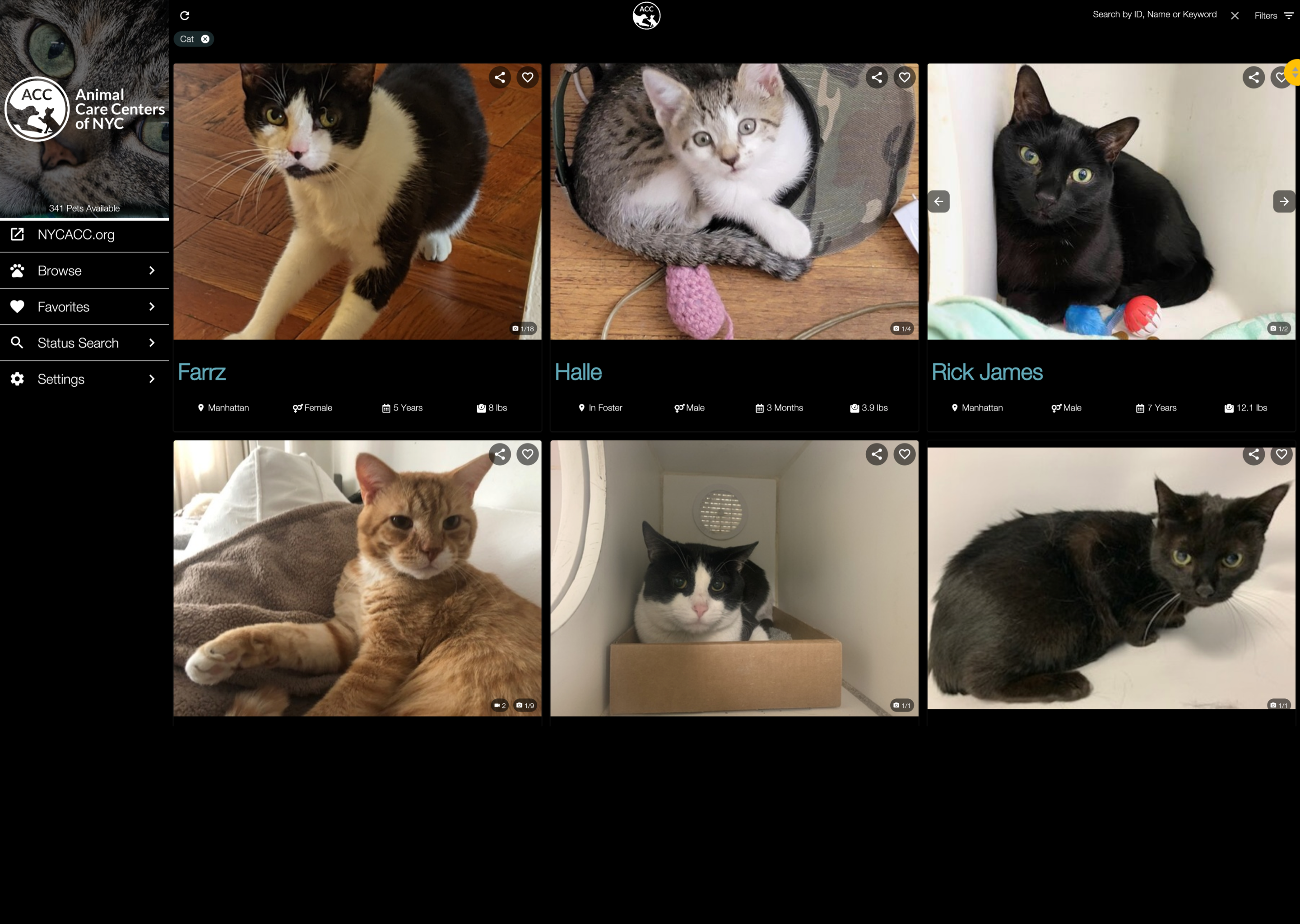
I was interested to know what other companies were doing to solve pet homelessness and whether what they were doing was actually working? I choose the three companies; PETtrac, Petco Love Lost and Pet Finder for their innovative interface and concept.
Strength
Efficient Standardized pet database that keeps track of microchips
Collaborates with a large range of users (Vet, shelters and Pet Owners)
Weakness
No indication of neuter status (a microchip pet can runaway and create a litter)
Owners without a microchip will not be serviced in finding pet
- No pet finding tips


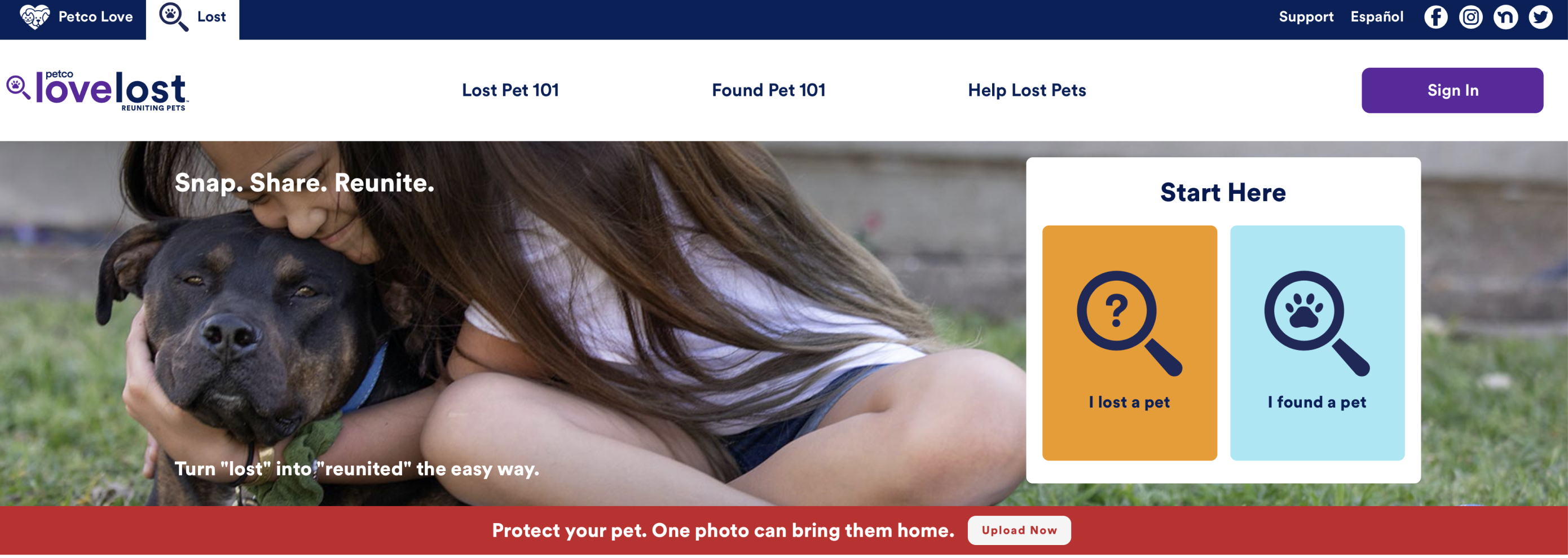
Strength
User interface alleviates cognitive overload and directs users to lost and found
Pet finding tips provided
Connected with social media influencers
- Easy AI facial recognition to match lost pet with shelter list
User interface alleviates cognitive overload and directs users to lost and found
Pet finding tips provided
Connected with social media influencers
- Easy AI facial recognition to match lost pet with shelter list
User interface alleviates cognitive overload and directs users to lost and found
Pet finding tips provided
Connected with social media influencers
- Easy AI facial recognition to match lost pet with shelter list
User interface alleviates cognitive overload and directs users to lost and found
Pet finding tips provided
Connected with social media influencers
- Easy AI facial recognition to match lost pet with shelter list
User interface alleviates cognitive overload and directs users to lost and found
Pet finding tips provided
Connected with social media influencers
- Easy AI facial recognition to match lost pet with shelter list
Weakness
Inability to request custom pieces
No information regarding whether material is ethically sourced
Inability to request custom pieces
No information regarding whether material is ethically sourced
Inability to request custom pieces
No information regarding whether material is ethically sourced
Inability to request custom pieces
No information regarding whether material is ethically sourced
Inability to request custom pieces
No information regarding whether material is ethically sourced

Strength
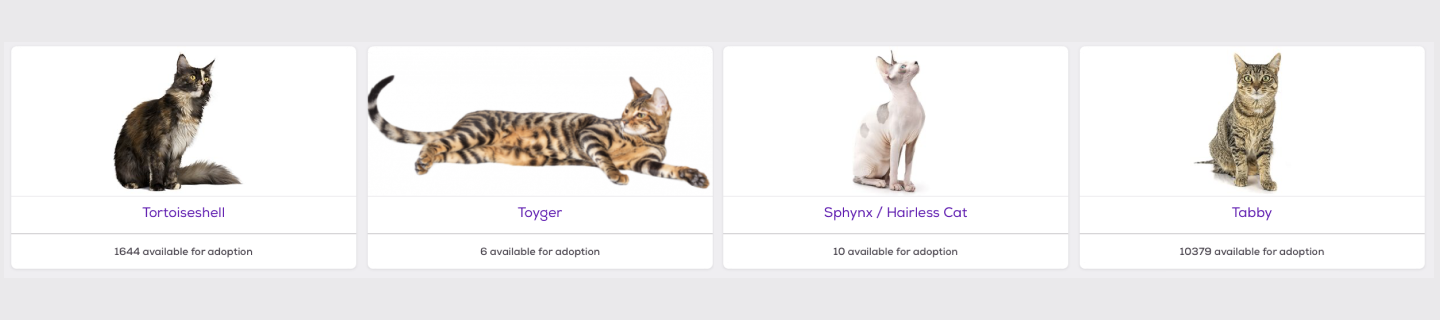
Flexible organizing system with a mix of descriptive types and breed type
Flexible organizing system with a mix of descriptive types and breed type
Flexible organizing system with a mix of descriptive types and breed type
Flexible organizing system with a mix of descriptive types and breed type
Weakness
No lost and found database system, only adoptions
No pet finding tips, only care taking tips
No lost and found database system, only adoptions
No pet finding tips, only care taking tips
No lost and found database system, only adoptions
No pet finding tips, only care taking tips
No lost and found database system, only adoptions
No pet finding tips, only care taking tips
Opportunities:
A system which is inclusive to both cautious and forgetful pet owners
Create a system which addresses pet homelessness entirely, adoption, lost, and found pets
Standardized device that can be tracked by different audiences (vet, shelter, neighbor, owner)
A system which is inclusive to both cautious and forgetful pet owners
Create a system which addresses pet homelessness entirely, adoption, lost, and found pets
Standardized device that can be tracked by different audiences (vet, shelter, neighbor, owner)
A system which is inclusive to both cautious and forgetful pet owners
Create a system which addresses pet homelessness entirely, adoption, lost, and found pets
Standardized device that can be tracked by different audiences (vet, shelter, neighbor, owner)
A system which is inclusive to both cautious and forgetful pet owners
Create a system which addresses pet homelessness entirely, adoption, lost, and found pets
Standardized device that can be tracked by different audiences (vet, shelter, neighbor, owner)
Twice as many animals enter the shelter as “strays” than they are to be relinquished by owners.
Shelters are not required to report to or manage a standardized database system
Pets have a short shelter stay and are euthanized frequently due to over crowdedness
Shelter workers are overworked, burned out and stressed, decreasing their cognitive ability to provide optimal care and help reunite pet with family.
Design audit
Design audit
Design audit
Design audit
Design audit
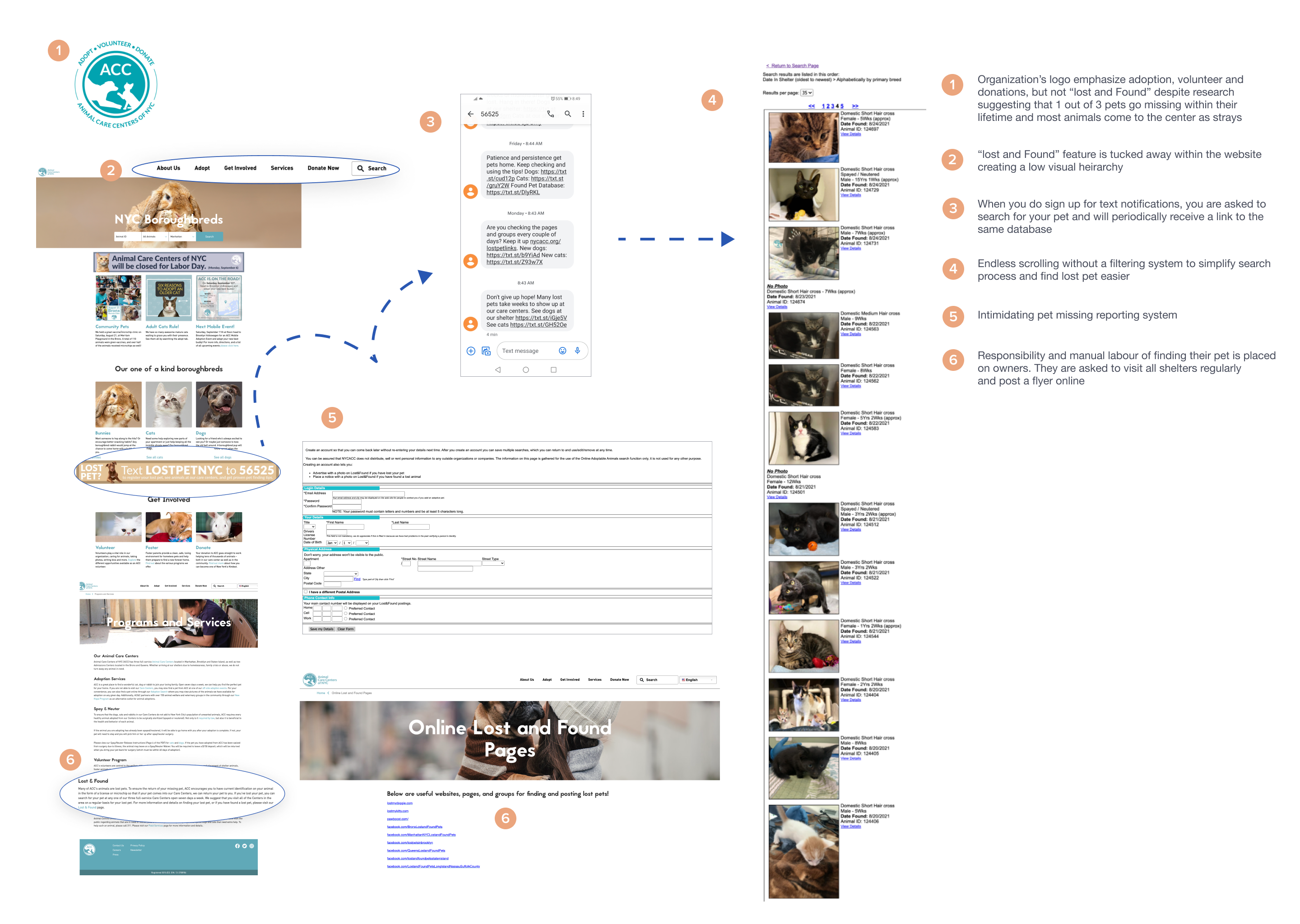
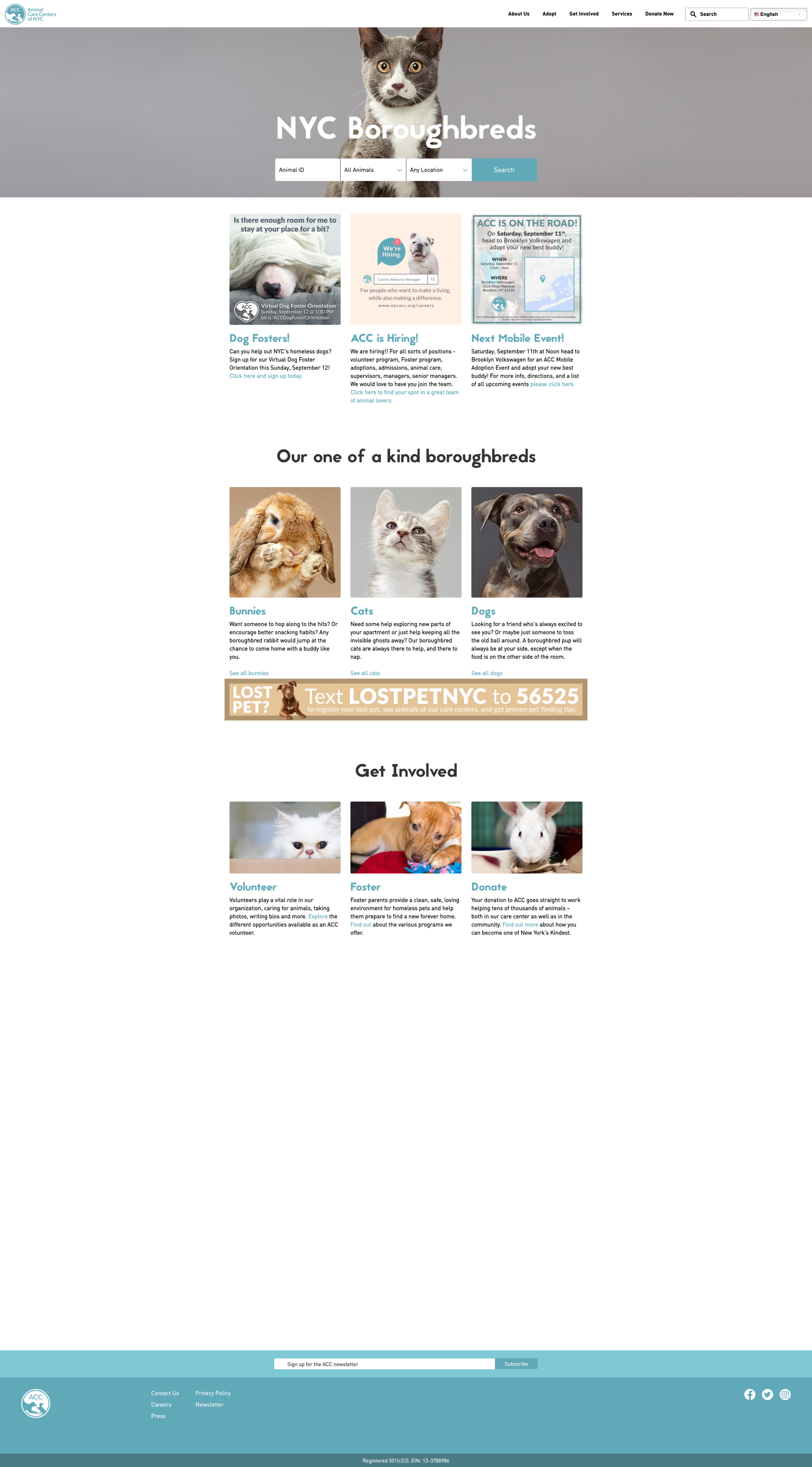
I conducted a design audit to see how Animal Care Centers of NYC (NYACC) compares to other websites and explore other potential opportunities. It was interesting to see how the website prioritizes adoption over “reuniting missing pets” and places the full responsibility on owners as they conduct their own search. The current system, as it is now, places a burden on animal loving workers (who euthanize pets after a short stay) and pet owners (who are asked to take full responsibility for their own search).
Explorative Interview
Explorative Interview
Explorative interview
Explorative interview
Explorative interview
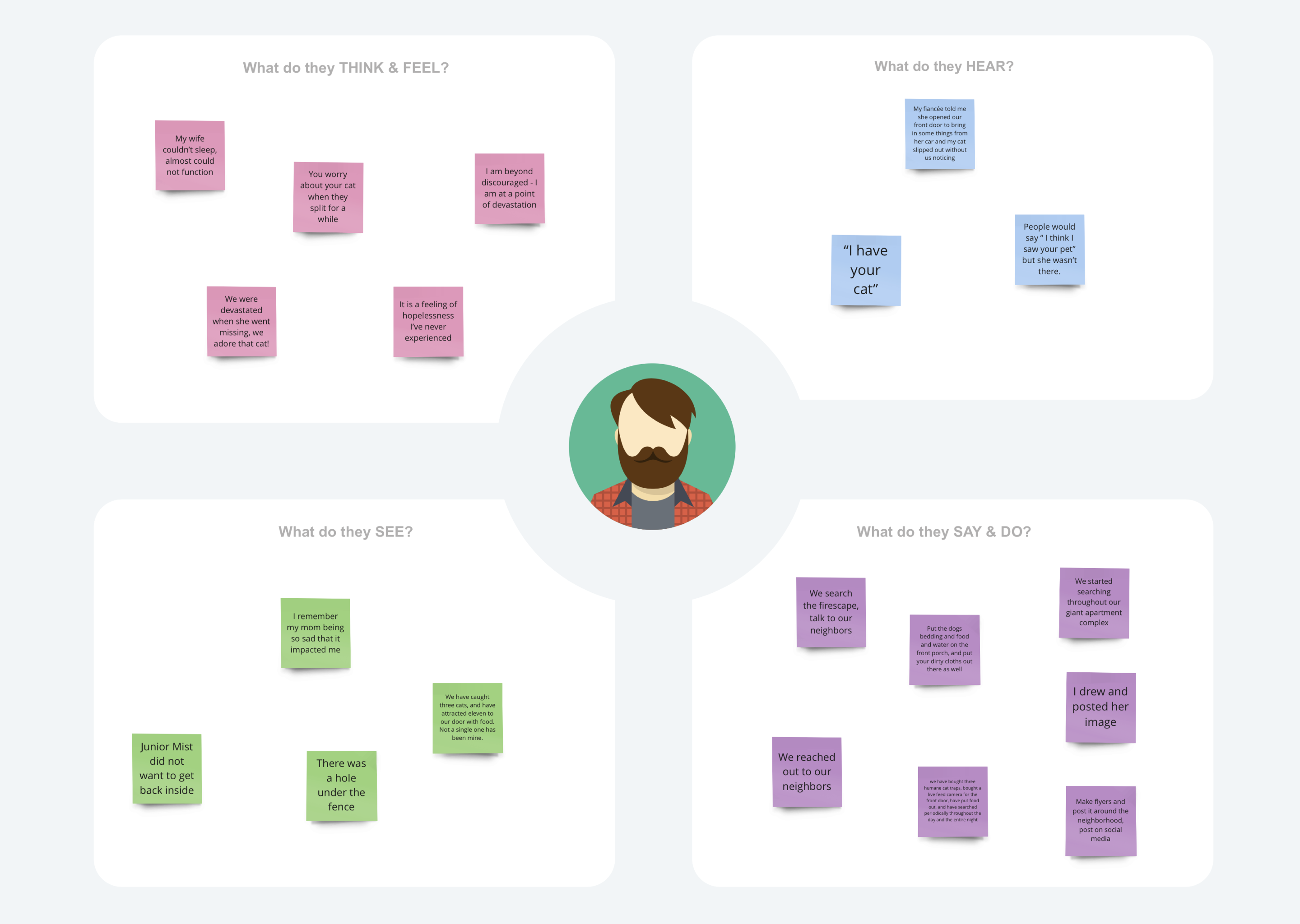
I interviewed pet owners and an animal shelter volunteer to validate my assumptions and results from the survey. It was interesting to hear how pet owners would rather create flyers or speak to neighbors about their lost pet rather than go to their local shelter, even though most animals enter as strays. There is a disconnect between what these interviewers think members in their community would do and what surveyors reported actually doing. 40% responded that they wouldn’t do anything to reunite a stray animal if spotted. I created an empathy to synthesize all collected data.
Defining our user personas
Defining our user
Defining our user
Defining our user personas
Defining our user personas
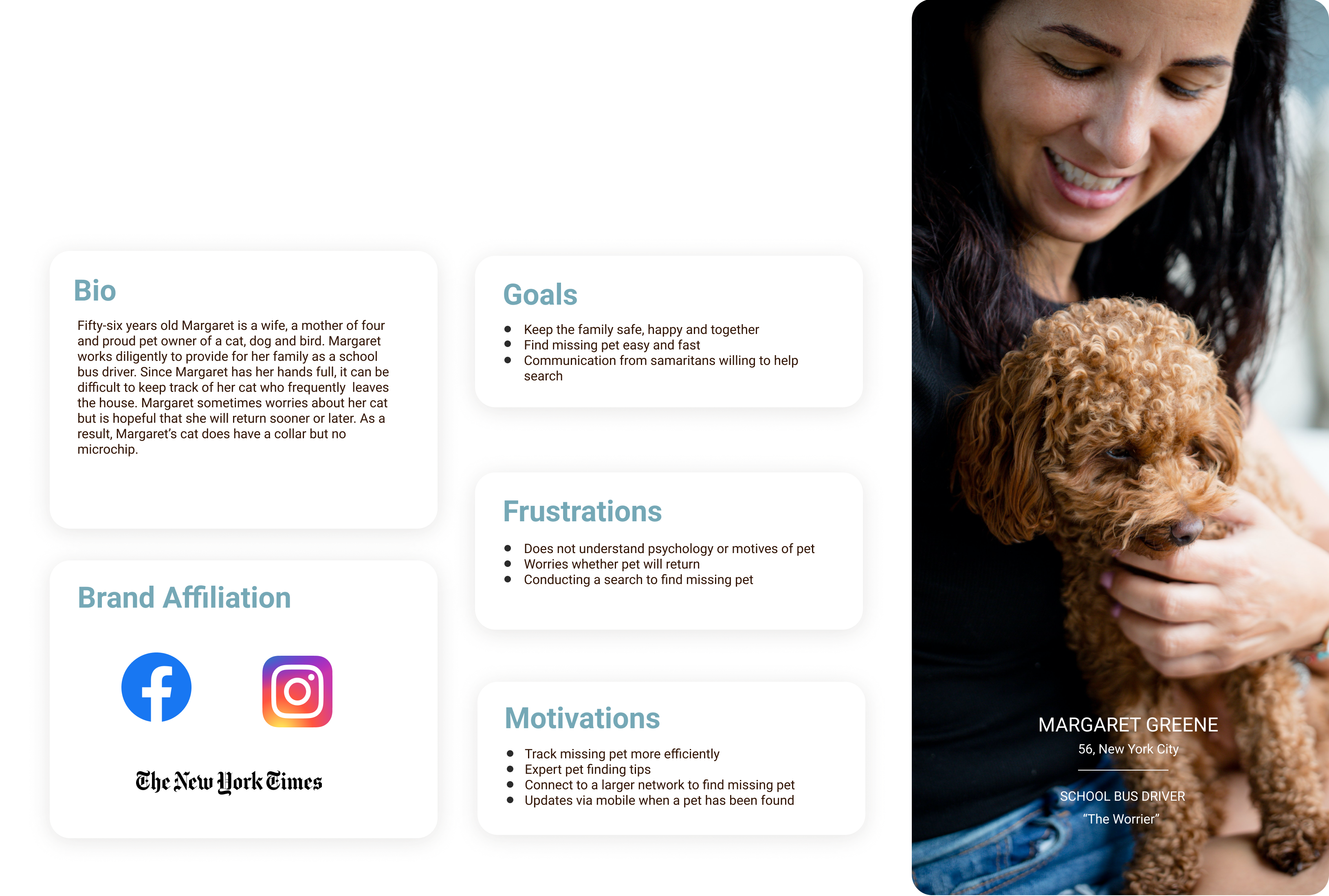
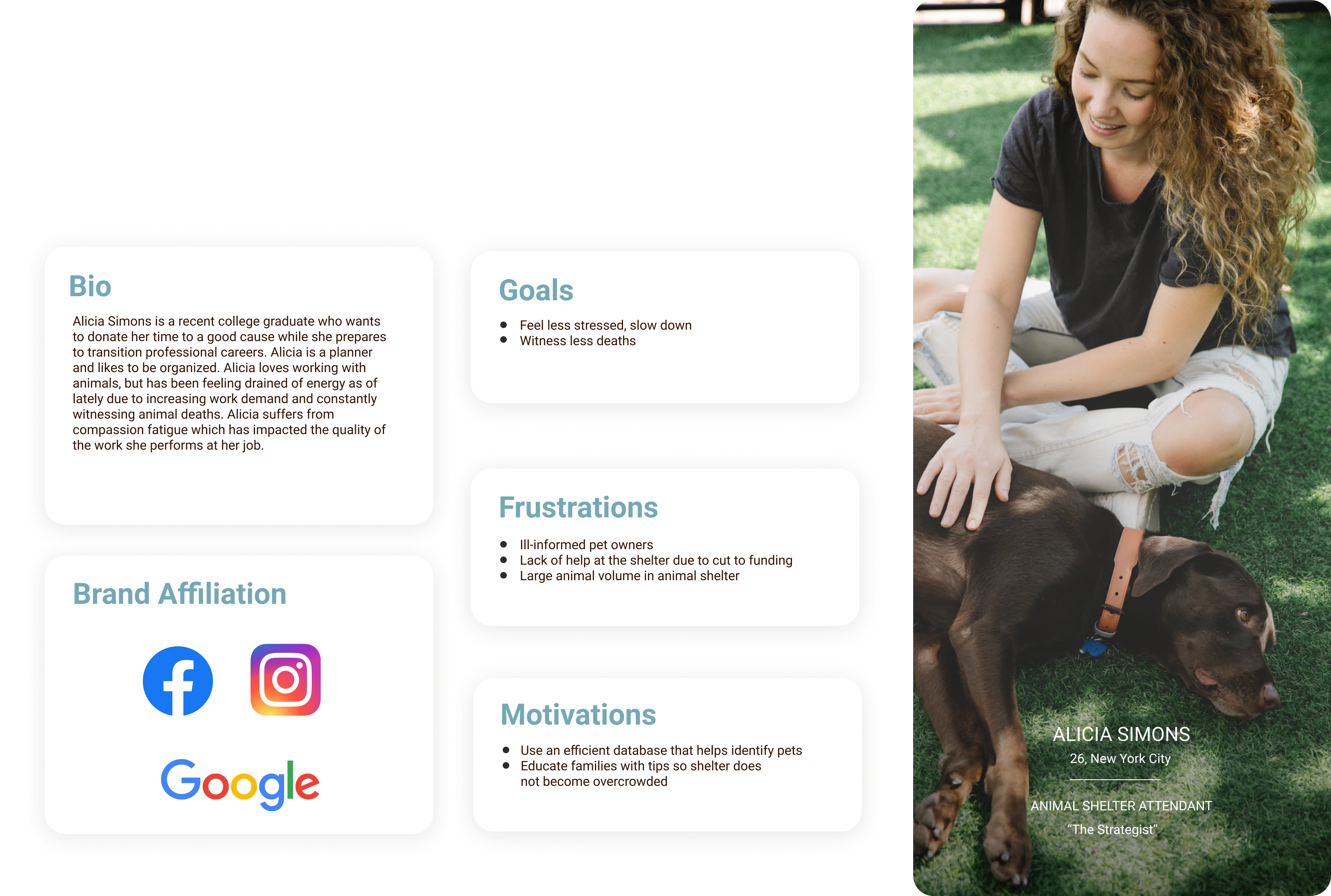
The following personas were created to synthesize everything learned about our target audience so far. This will come in handy later when we think through what kind of features our product should have in order to meet the needs of our consumers. Although I could have incorporated more personas (veterinarian and neighbors) I’ve decided to focus on pet owners and shelter staff as they are the most impacted by this problem.
Product Roadmap
Product Roadmap
Product feature roadmap
Product feature roadmap
Product feature roadmap
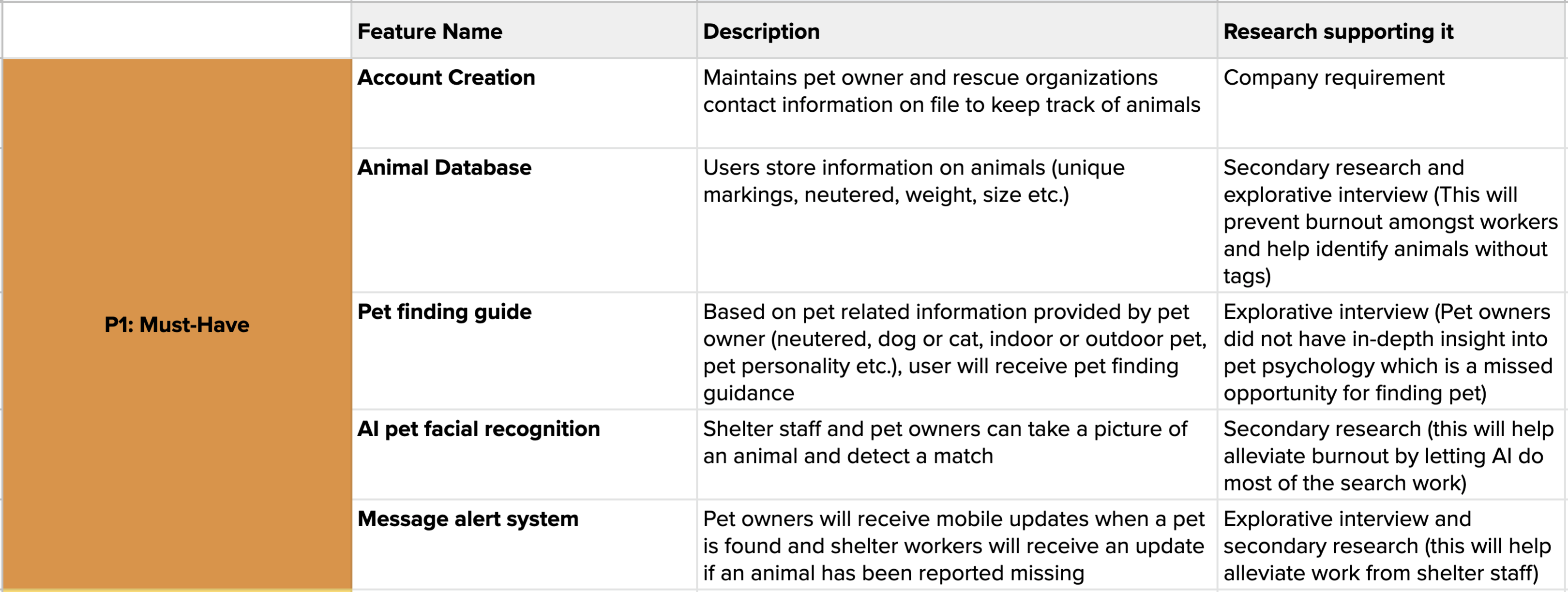
I collected all of the information from the secondary research and explorative interview to identify and prioritize the most essential features. I knew we needed a standardized database that provided updated information in real time, pet finding tips, a way to categorize pets by markings and AI facial recognition to reduce cognitive burden on shelter staff and pet owners.
Flow chart
Flow chart
Flow chart
Flow chart
Flow chart
Once all of the features has been defined, I created a sitemap, task and user flow to distinguish the website layout. I wanted to create a quick and easy pet searching navigation system for every user including neighbors, vets, shelter staff, worried pet owners and those looking to adopt. If the user does not find their pet, they will have the option to report them missing, create an account to receive updated texts and to share pre-created posters.

Ideation
Ideation
Ideation
Ideation
Ideation
I played with different design concepts, looking for the best way to create a visible centralized touch point for both shelter staff and pet owners to locate lost or found pets. It was important to incorporate distinct icons to make it easier for the user to scan and process information, reducing cognitive overload.

Usability Test
Usability Test
Usability Test
Usability Test
Usability Test
After choosing the best design, I conducted a card sorting exercise and paper prototype test with three pet owners to validate my navigation concept. I wanted to test whether the pet reporting user flow was intuitive and easy to use. Likewise, I wanted to test whether the users would be able to all categorize pets the same way.
Assumptions:
All users have the capacity to universally categorize pets
Users will be able to complete the task of entering their pet’s information into the database
Users will either use the AI facial recognition button or the centralized pet database touchpoint.
All users have the capacity to universally categorize pets
Users will be able to complete the task of entering their pet’s information into the database
Users will either use the AI facial recognition button or the centralized pet database touchpoint.
All users have the capacity to universally categorize pets
Users will be able to complete the task of entering their pet’s information into the database
Users will either use the AI facial recognition button or the centralized pet database touchpoint.
All users have the capacity to universally categorize pets
Users will be able to complete the task of entering their pet’s information into the database
Users will either use the AI facial recognition button or the centralized pet database touchpoint.
All users have the capacity to universally categorize pets
Users will be able to complete the task of entering their pet’s information into the database
Users will either use the AI facial recognition button or the centralized pet database touchpoint.
Objectives:
To determine...
if our consumers are able to universally category cats by feature types
Ease of reporting a lost cat
if our consumers are able to universally category cats by feature types
Ease of reporting a lost cat
if our consumers are able to universally category cats by feature types
Ease of reporting a lost cat
if our consumers are able to universally category cats by feature types
Ease of reporting a lost cat
if our consumers are able to universally category cats by feature types
Ease of reporting a lost cat
Task 1:
For the card sort, users were given three cats and were told to assign traits (fur pattern, color, unique markings, etc) to each
For the card sort, users were given three cats and were told to assign traits (fur pattern, color, unique markings, etc) to each
For the card sort, users were given three cats and were told to assign traits (fur pattern, color, unique markings, etc) to each
For the card sort, users were given three cats and were told to assign traits (fur pattern, color, unique markings, etc) to each
For the card sort, users were given three cats and were told to assign traits (fur pattern, color, unique markings, etc) to each
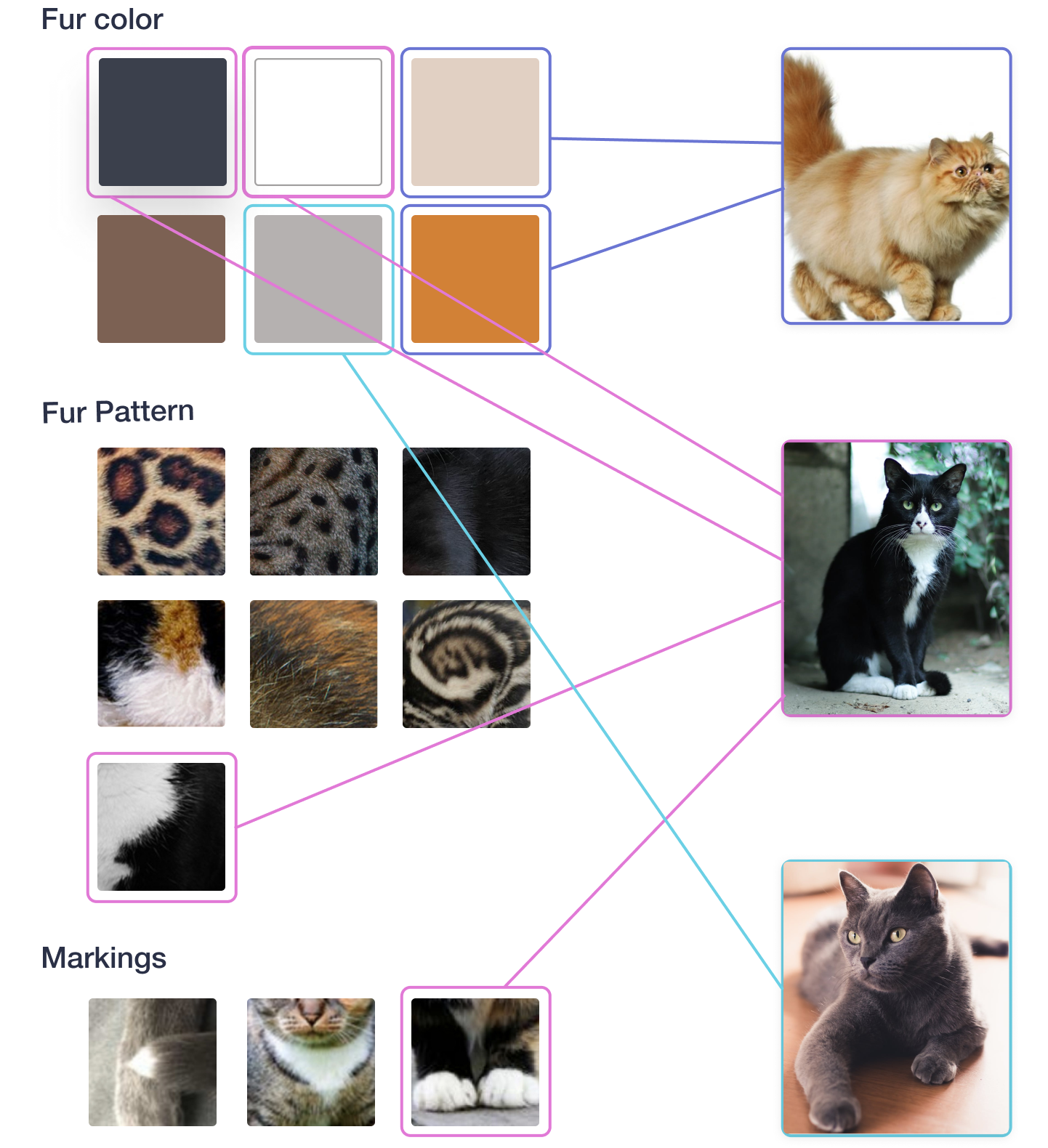
Task 2:
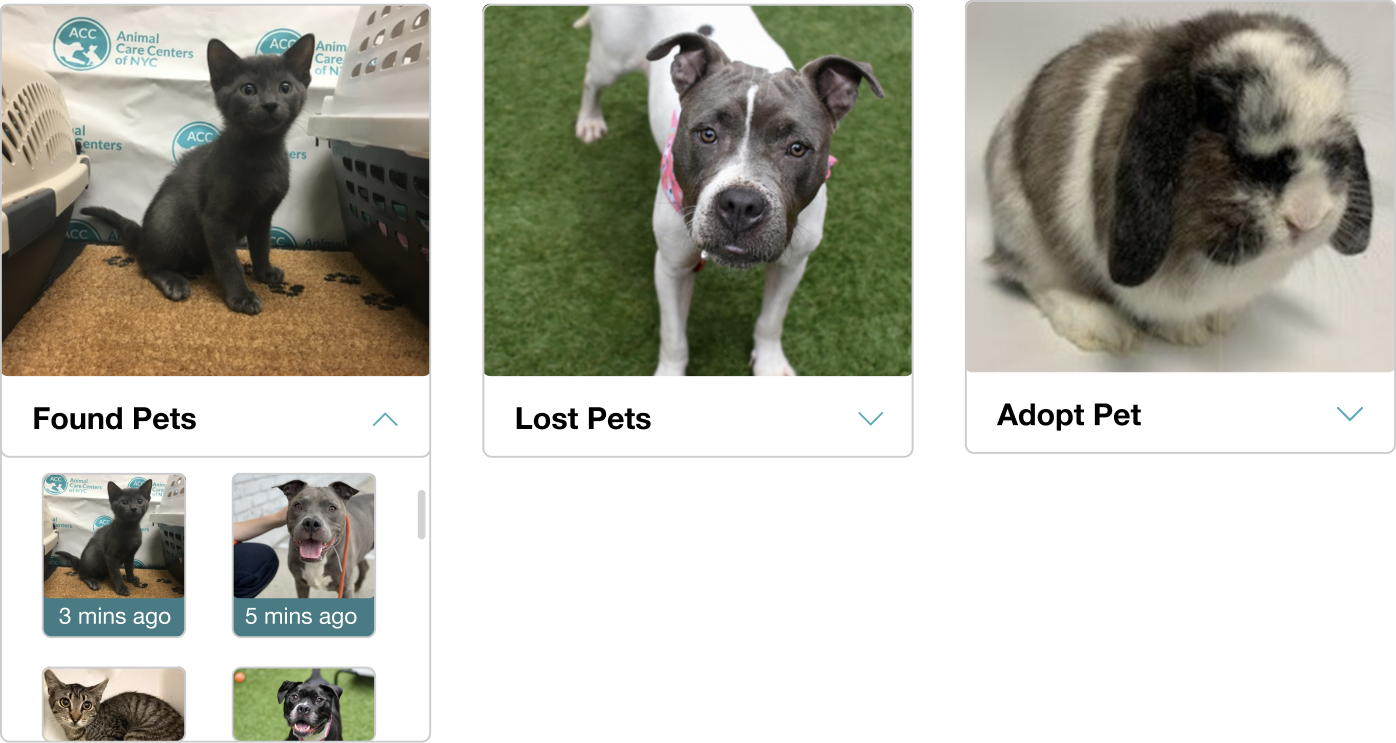
Users were asked to find their missing cat using a paper prototype using the following centralized pet database component:
Users were asked to find their missing cat using a paper prototype using the following centralized pet database component:
Users were asked to find their missing cat using a paper prototype using the following centralized pet database component:
Users were asked to find their missing cat using a paper prototype using the following centralized pet database component:
Users were asked to find their missing cat using a paper prototype using the following centralized pet database component:
Results
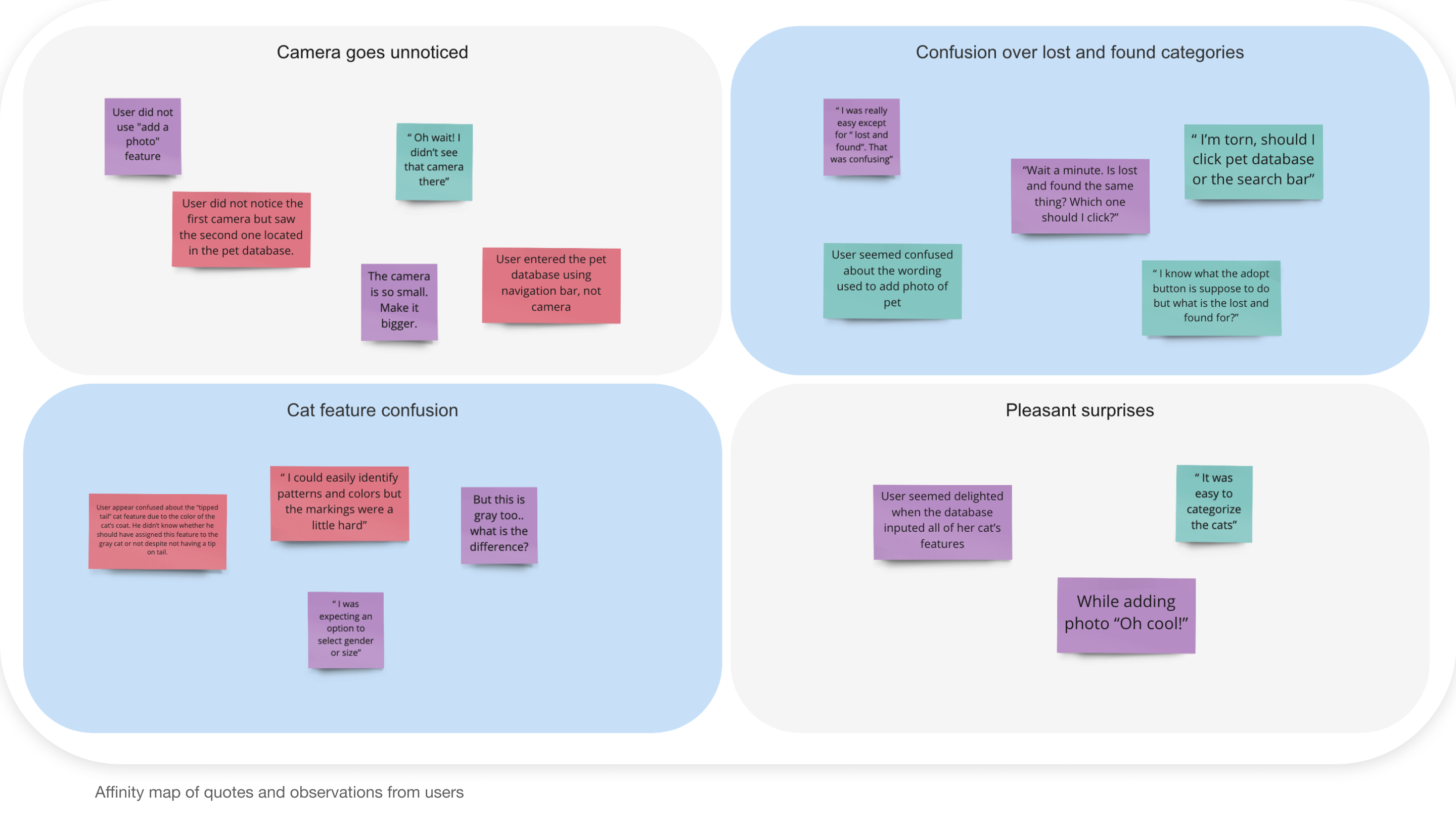
Generally, users found the task of reporting a missing pet and categorizing cats, easy. However, there were some navigational problems. I created an affinity map to explore the trends between user quotes and behavior observations. Patterns discovered include difficulty locating the facial recognition feature, confusing the difference between “lost” and “found” labels and a delay around categorizing unique markings.
Opportunities:
Create custom icons for “unique markings” as having an actual picture of a cat, confuses users.
Make AI facial recognition camera button more visible
Add more identifiers such as “size” and “ gender”
Create a more intuitive “Lost and found” label
Create custom icons for “unique markings” as having an actual picture of a cat, confuses users.
Make AI facial recognition camera button more visible
Add more identifiers such as “size” and “ gender”
Create a more intuitive “Lost and found” label
Create custom icons for “unique markings” as having an actual picture of a cat, confuses users.
Make AI facial recognition camera button more visible
Add more identifiers such as “size” and “ gender”
Create a more intuitive “Lost and found” label
Create custom icons for “unique markings” as having an actual picture of a cat, confuses users.
Make AI facial recognition camera button more visible
Add more identifiers such as “size” and “ gender”
Create a more intuitive “Lost and found” label
Create custom icons for “unique markings” as having an actual picture of a cat, confuses users.
Make AI facial recognition camera button more visible
Add more identifiers such as “size” and “ gender”
Create a more intuitive “Lost and found” label
High-fidelity mockup
High-fidelity mockup
High-fidelity mockup
High-fidelity mockup
High-fidelity mockup
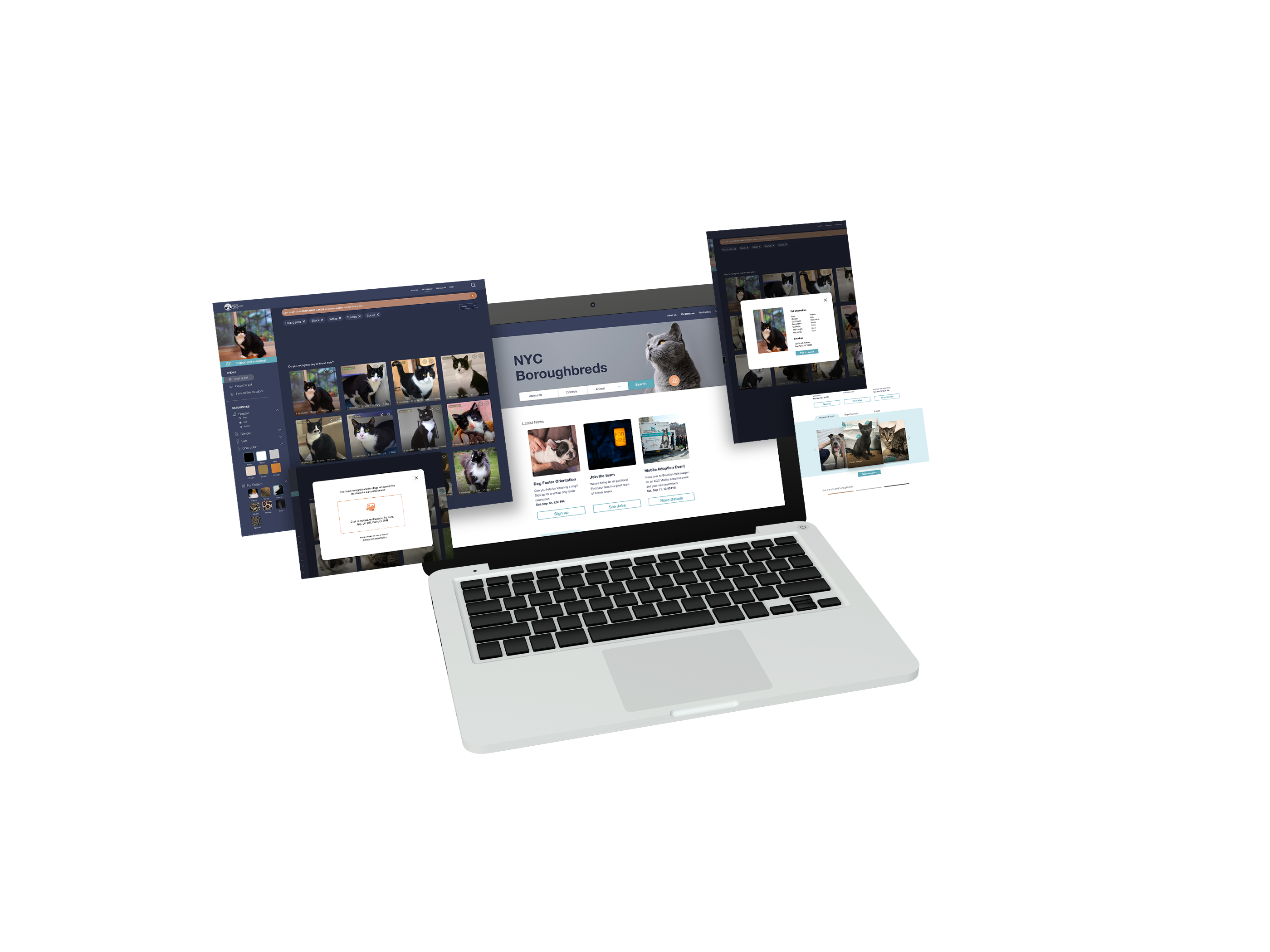
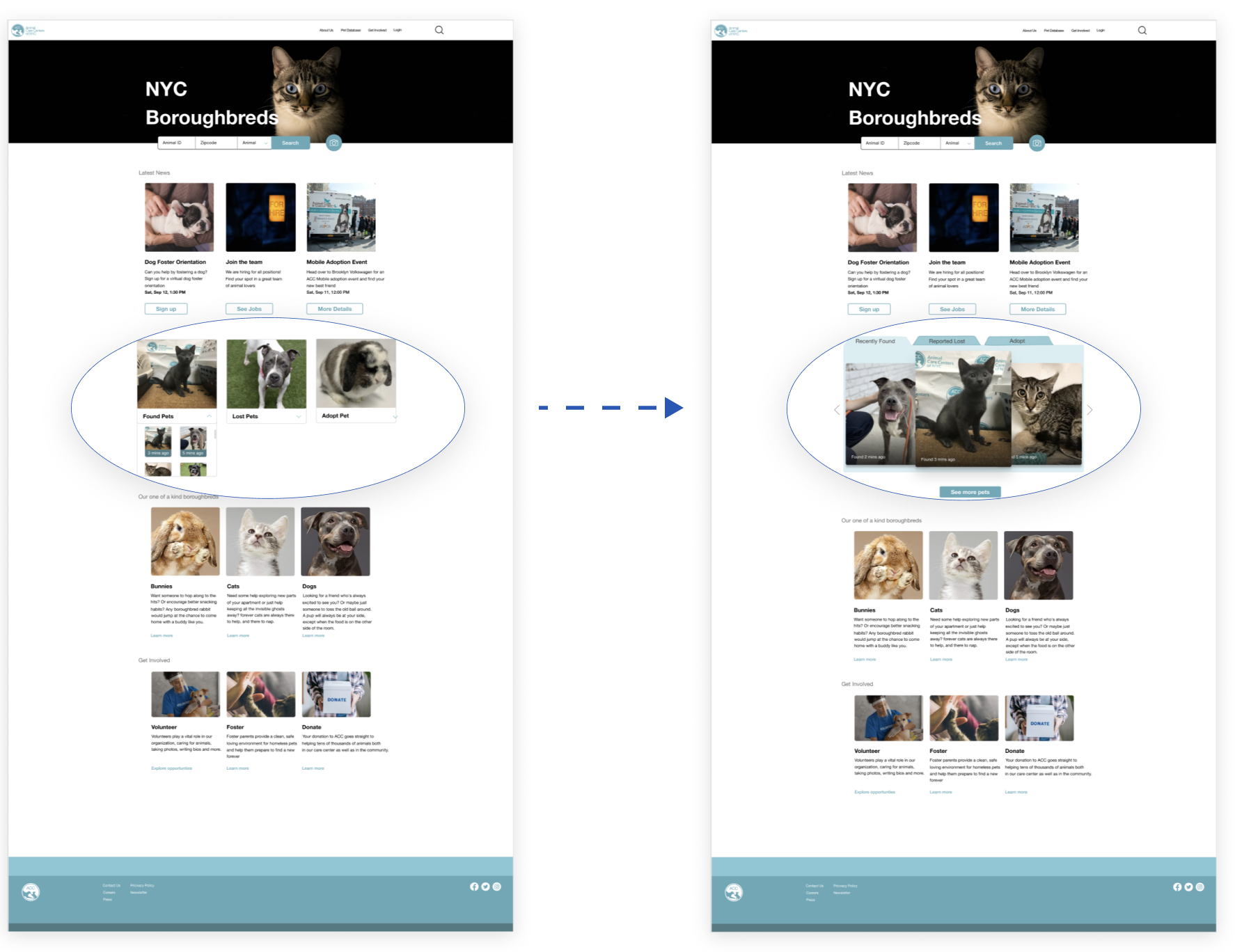
A hi-fi mockup was created and iterated upon based on feedback. I changed the original centralized "lost and found" UI component. It was replaced with a “manila folder” for two reasons; it creates a visual hierarchy, making it easier to find at first glance and because it mimics the natural feeling of searching through records.
Revision 1:
Changed wording from “Found, Lost and adopted pets” to “Recently found, Reported lost and Adopt” as testers felt uncertain of where the original links would take them
Added a gallery scrolling feature so frantic pet owners can have a better view of animals recently found at first glance
Created “manila folder” containers around “lost and found” pet section to make it distinguishable and work with our natural schema of using folders to organize important paperwork.
Changed wording from “Found, Lost and adopted pets” to “Recently found, Reported lost and Adopt” as testers felt uncertain of where the original links would take them
Added a gallery scrolling feature so frantic pet owners can have a better view of animals recently found at first glance
Created “manila folder” containers around “lost and found” pet section to make it distinguishable and work with our natural schema of using folders to organize important paperwork.
Changed wording from “Found, Lost and adopted pets” to “Recently found, Reported lost and Adopt” as testers felt uncertain of where the original links would take them
Added a gallery scrolling feature so frantic pet owners can have a better view of animals recently found at first glance
Created “manila folder” containers around “lost and found” pet section to make it distinguishable and work with our natural schema of using folders to organize important paperwork.
Changed wording from “Found, Lost and adopted pets” to “Recently found, Reported lost and Adopt” as testers felt uncertain of where the original links would take them
Added a gallery scrolling feature so frantic pet owners can have a better view of animals recently found at first glance
Created “manila folder” containers around “lost and found” pet section to make it distinguishable and work with our natural schema of using folders to organize important paperwork.
Changed wording from “Found, Lost and adopted pets” to “Recently found, Reported lost and Adopt” as testers felt uncertain of where the original links would take them
Added a gallery scrolling feature so frantic pet owners can have a better view of animals recently found at first glance
Created “manila folder” containers around “lost and found” pet section to make it distinguishable and work with our natural schema of using folders to organize important paperwork.
Revision 2 and 3:
Changed the top navigation and footer color to make it more cohesive with database
Changed the color of the facial recognition camera feature button to
orange to create a higher contrast and noticabilityExtended the “manila folder” container across the page and took out unactive folder tabs to reduce clutter
Moved the search bar further up to make it easier to code for software developer
Changed the top navigation and footer color to make it more cohesive with database
Changed the color of the facial recognition camera feature button to
orange to create a higher contrast and noticabilityExtended the “manila folder” container across the page and took out unactive folder tabs to reduce clutter
Moved the search bar further up to make it easier to code for software developer
Changed the top navigation and footer color to make it more cohesive with database
Changed the color of the facial recognition camera feature button to
orange to create a higher contrast and noticabilityExtended the “manila folder” container across the page and took out unactive folder tabs to reduce clutter
Moved the search bar further up to make it easier to code for software developer
Changed the top navigation and footer color to make it more cohesive with database
Changed the color of the facial recognition camera feature button to
orange to create a higher contrast and noticabilityExtended the “manila folder” container across the page and took out unactive folder tabs to reduce clutter
Moved the search bar further up to make it easier to code for software developer
Changed the top navigation and footer color to make it more cohesive with database
Changed the color of the facial recognition camera feature button to
orange to create a higher contrast and noticabilityExtended the “manila folder” container across the page and took out unactive folder tabs to reduce clutter
Moved the search bar further up to make it easier to code for software developer
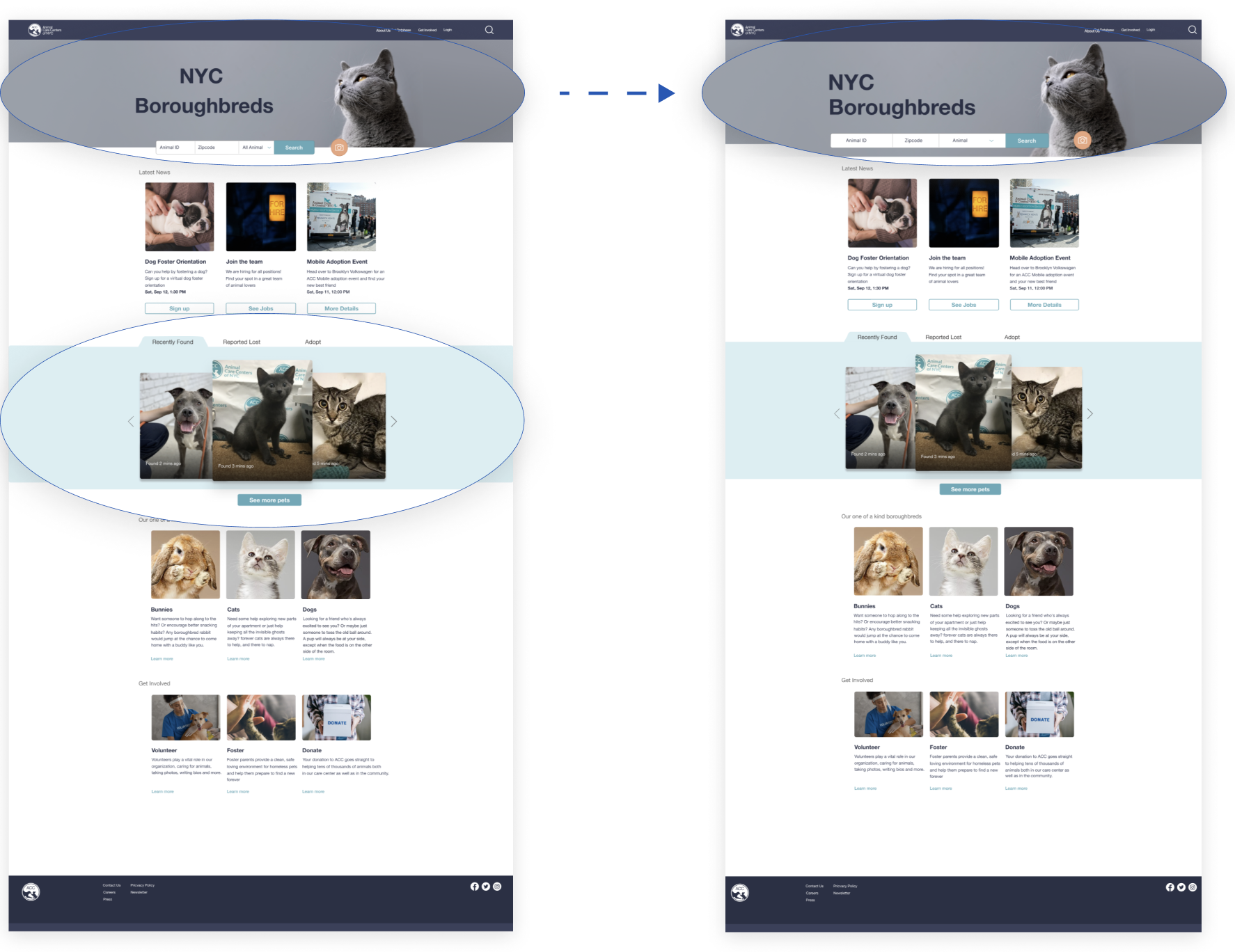
Slide handle to see original and redesign
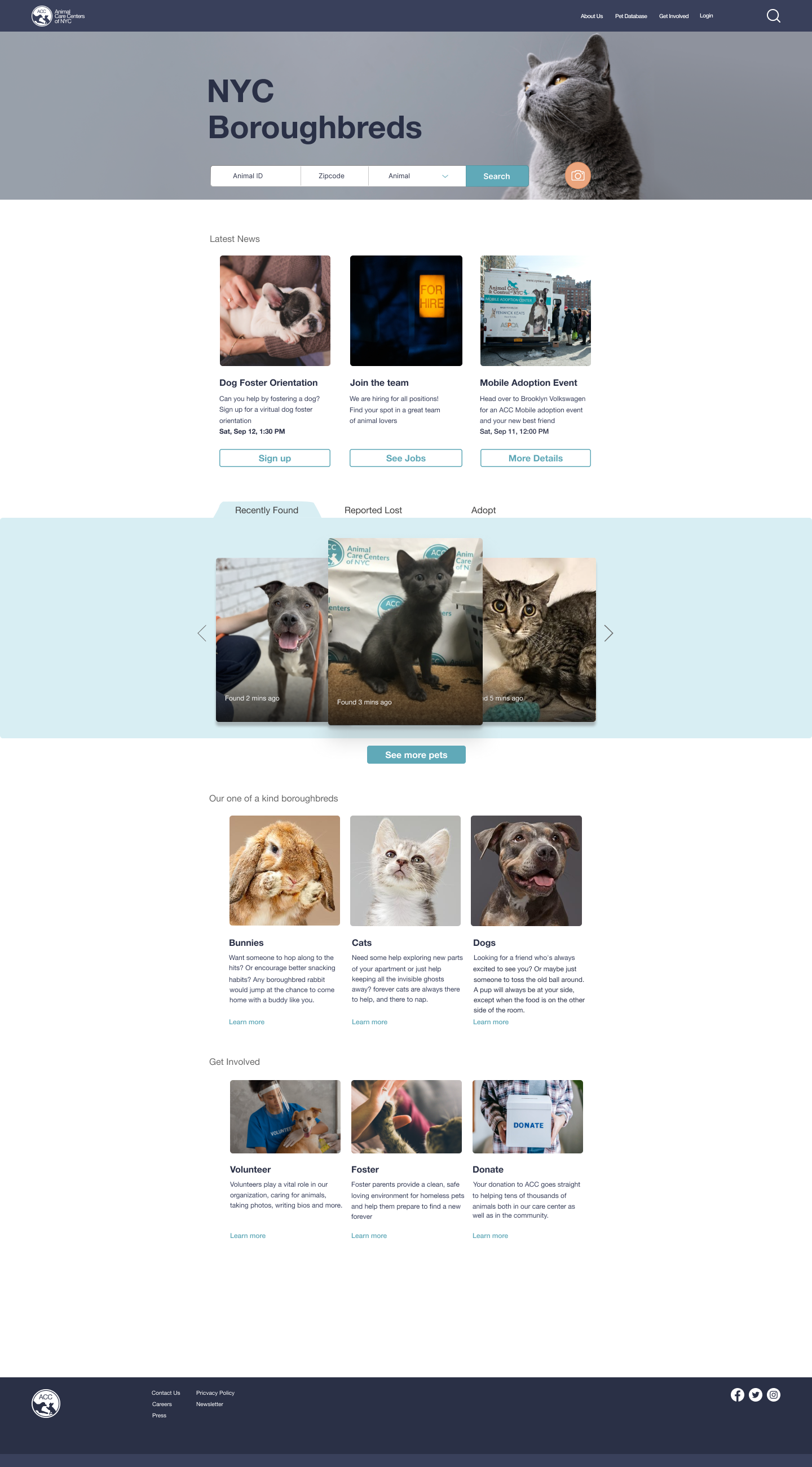
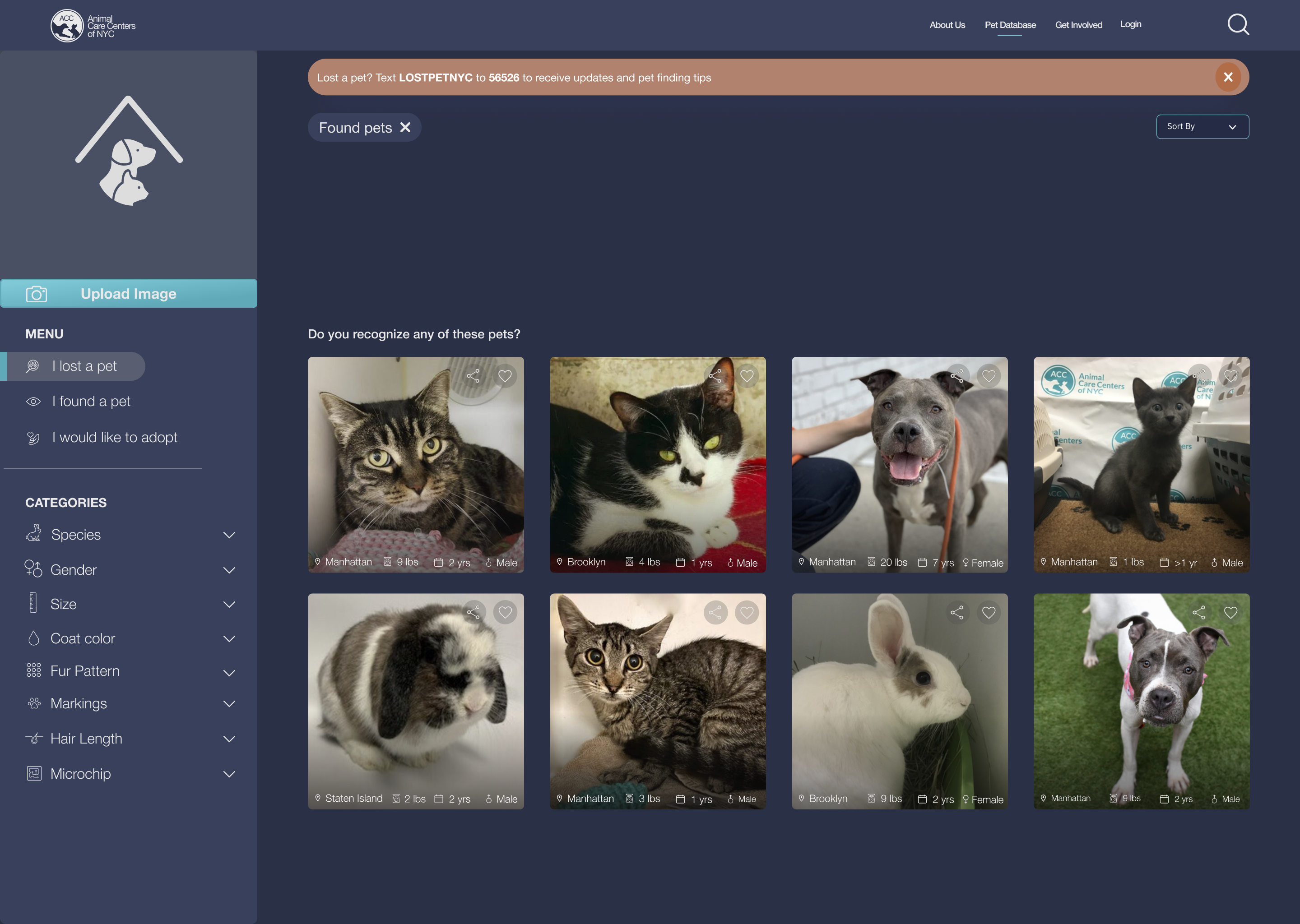
Final Prototype
Final Prototype
Final Prototype
Final Prototype
Final Prototype
Reflection
Reflection
Reflection
Reflection
Reflection
I originally intended to create a better pet reporting form, however, after doing research, it has become apparent to me that upgrading the database could yield a greater impact. Ultimately, there is a disconnect in communication between shelter staff and worried pet owners, shelter staff experience burn out from an overload of responsibilities and pet owners generally do not know best practices for finding lost pets on their own. To make matters worse, NYACC places full responsibility on the pet owner to followup and find their own pet. This could be due to worker burnout as there is no system in place to alleviate burden for both parties. NYACC could benefit from a flow system for neighbors, pet owners and shelter staff to aid one another in their joint mission of keeping pets safe.
Given more time, I would have created a user flow for someone who lost a pet, pet finding tips for guidance and a text messaging system so owners can receive live updates, as these are much needed. If I could go back, I would re-word a question in my user survey due to it’s misleading nature, I received mixed results. I also learned that an empathy map should be completed prior to a user interview. For future projects, I plan to use the affinity map to synthesize findings instead.
More projects
More project
More projects
More Projects
More Projects

THOUGHTFUL
Fixing a leaky customer funnel.
Growth • B2C SaaS • Animation
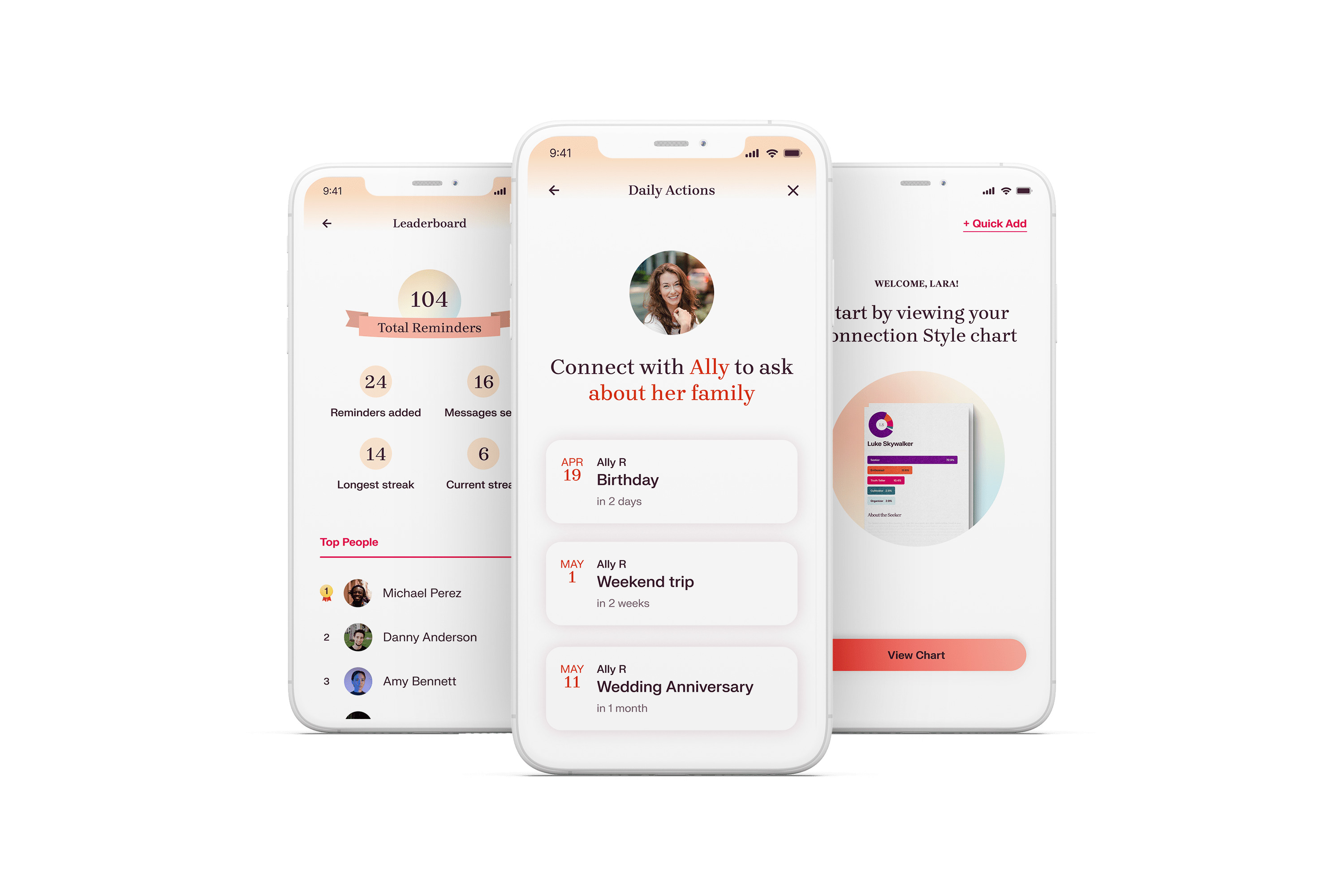
THOUGHTFUL
Boosting Retention by unlocking user ‘Aha’ Moment.
Product discovery • iOS Mobile
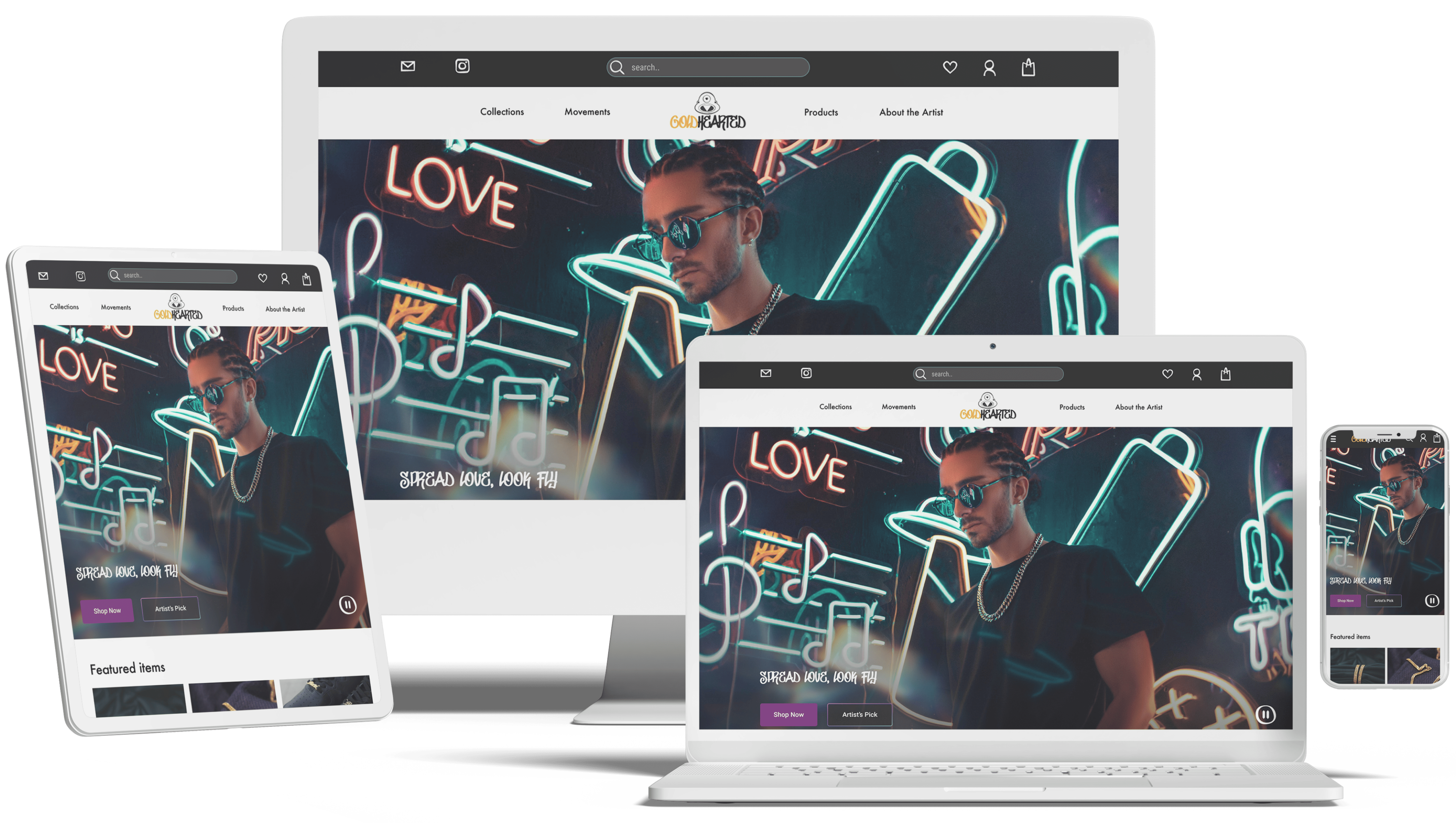
GOLD HEARTED
Rebrand a jewelry company for market fit.
Responsive • E-commerce • Visual

NETFLIX
Enhance accessibility for better control.
Feature redesign • Microinteraction